NZS 8510 Compliant Meth Test: The Gold Standard for Waikato Properties

Updated: Apr 7
A non-compliant methamphetamine test provides nothing more than a false sense of security that can vanish the moment a legal dispute or insurance claim arises. Most property owners in the Waikato understand that inconsistent results often lead to significant financial liability, especially when testing fails to meet the rigorous benchmarks established in June 2017. Securing an nzs 8510 compliant meth test isn't just a procedural hurdle; it's a technical necessity for maintaining Healthy Homes standards and ensuring your insurance policy remains valid. We recognize the frustration caused by varying results that lack scientific backing and leave your assets exposed to risk.
This analysis details the technical requirements of NZS 8510:2017 to ensure your property testing is legally robust and scientifically accurate. You'll gain a clear understanding of the sampling methodologies, laboratory requirements, and reporting standards that constitute the industry's gold standard. We'll outline the specific steps required to achieve a defensible report that protects your family, tenants, and long-term investment in the New Zealand property market.
Key Takeaways
Learn why adhering to the NZS 8510:2017 standard is essential for ensuring your property testing meets current New Zealand legislative requirements and scientific benchmarks.
Understand the technical implications of the 1.5 µg/100cm² universal threshold and how precise sampling protocols protect your investment from inaccurate results.
Discover the strategic differences between laboratory composite screening and individual room testing to determine which nzs 8510 compliant meth test approach best suits your property's needs.
Identify the specific legal protections available to Waikato landlords under the Residential Tenancies Act and how standard-compliant testing mitigates regional contamination risks.
Evaluate the importance of independent testing and the "conflict of interest" rule to ensure your decontamination decisions are based on unbiased, professional data.
Table of Contents
What is an NZS 8510 Compliant Meth Test?
An nzs 8510 compliant meth test represents the technical benchmark for assessing chemical residue in New Zealand residential properties. This standard, formally titled NZS 8510:2017, provides a rigorous framework for the inspection, sampling, and laboratory analysis of properties suspected of contamination. Before understanding the testing protocols, it's useful to review What is Methamphetamine? to grasp the chemical persistence of the substance. Unlike rudimentary screening, a compliant test ensures that every procedure follows a documented, audited methodology. This eliminates the technical variability often found in non-regulated sampling practices.
Compliance means more than just obtaining a numerical result. It requires a clear separation of duties between the testing agency and the decontamination contractor to prevent conflicts of interest. Under the standard, an independent third party must conduct the initial assessment and the final post-remediation verification. This structure ensures that the data remains objective and that the property owner receives an unbiased evaluation of the building's safety.
The Origin of the 2017 Standard
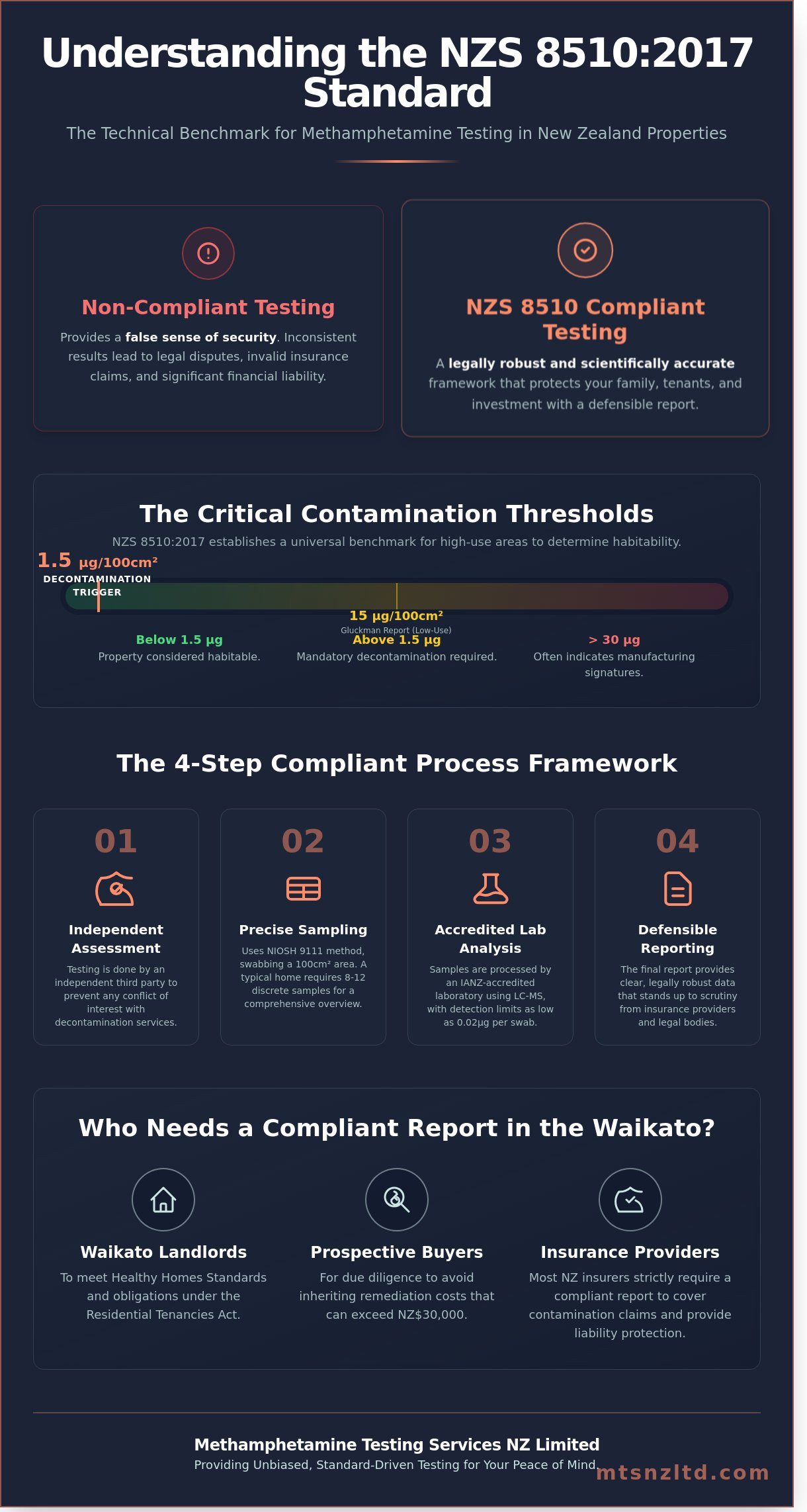
The New Zealand government introduced NZS 8510 in June 2017 to bring order to a previously unregulated market. While the 2018 Gluckman report introduced a 15μg/100cm² threshold for "low-use" contamination, the 2017 standard remains the primary legal baseline for decontamination and insurance liability. A primary distinction lies in laboratory involvement. DIY "instant" kits often produce false positives or fail to detect low-level residue. A compliant nzs 8510 compliant meth test requires samples to be processed by an IANZ-accredited laboratory using Liquid Chromatography-Mass Spectrometry (LC-MS). This precision allows for detection limits as low as 0.02μg per swab, providing a level of certainty that field kits cannot match.
The accuracy of these sensitive instruments is paramount, which is why laboratories rely on expert calibration services from companies such as CPS (NZ) Ltd to maintain IANZ accreditation and ensure legally defensible results.
Who Needs a Compliant Report in 2026?
By 2026, the demand for verified reporting in the Waikato region has intensified due to evolving legal obligations and risk management protocols. Key stakeholders include:
Waikato Landlords: Meeting the Healthy Homes Standards and the Residential Tenancies Act requires evidence that a property is provided in a reasonable state of cleanliness.
Prospective Buyers: In Hamilton and Te Awamutu, due diligence now necessitates a 1.5μg/100cm² baseline check to avoid inheriting remediation costs that can exceed NZ$30,000.
Insurance Providers: Most major New Zealand insurers strictly require a compliant report before they'll cover contamination claims or provide liability protection.
Professional testing provides the technical data necessary to make informed financial decisions. It's the only way to prove a property meets the safety requirements set by New Zealand law.
Technical Requirements of NZS 8510:2017
Adherence to the NZS 8510:2017 Standard ensures that every nzs 8510 compliant meth test follows a repeatable, scientifically valid process. This framework eliminates the variability seen in the New Zealand market prior to June 2017. It provides a technical blueprint for sampling, analysis, and reporting that protects both property owners and tenants. By following these regulations, technicians provide a defensive layer of data that stands up to legal and insurance scrutiny.
The 1.5 µg/100cm² Threshold Explained
The standard establishes a universal threshold of 1.5 micrograms per 100 square centimetres (µg/100cm²) for high-use areas. This figure is the benchmark for human habitability in New Zealand. It's necessary to distinguish between "use" signatures and "manufacture" signatures during the assessment. While personal use might result in localized contamination, clandestine manufacturing often leaves a chemical footprint exceeding 30 µg/100cm² along with precursor residues. Any result surpassing the 1.5 µg/100cm² limit triggers mandatory decontamination to restore the property to a legally habitable state.
Sampling Methodology and NIOSH 9111
Technicians must employ the NIOSH 9111 wipe sampling method to ensure data accuracy. This involves using a 10cm by 10cm template to swab exactly 100cm² of surface area. For a standard three-bedroom Waikato home, the protocol typically requires between 8 and 12 individual discrete samples to provide a comprehensive overview of the property. High-use areas and surfaces that accumulate airborne particles are prioritized:
Kitchen extractors and the tops of overhead cabinetry.
Heat pump internal filters and intake fins, which act as air scrubbers.
Bathroom ventilation points and high-touch surfaces.
Master bedroom wardrobes and ceiling corners.
Documentation is a core requirement of the standard. A professional report must include a detailed site plan indicating precise sampling locations. Every swab is documented with photographic evidence at the moment of collection. To maintain technical integrity, a strict chain of custody is enforced. This ensures samples remain sealed and tracked from the Waikato property to the IANZ-accredited laboratory without risk of tampering. You can review our technical testing protocols to see how we implement these requirements on every site. This level of precision minimizes liability and provides a definitive record of the property’s health status.
Composite vs. Individual Testing: Choosing the Right Method
Selecting the appropriate methodology for an nzs 8510 compliant meth test depends on the property's history and the client's risk management objectives. Laboratory composite screening serves as the primary diagnostic tool for the majority of residential assessments in the Waikato region. This method provides a high level of technical accuracy while maintaining cost efficiency for property owners. When contamination levels exceed the 1.5 µg/100cm² threshold established by the 2017 standard, a transition to detailed individual testing is required to define the scope of remediation.
Laboratory Composite Screening
Laboratory composite screening involves a process where technicians collect multiple swabs from different rooms, which the laboratory then combines into a single sample for analysis. This approach significantly reduces laboratory fees; testing typically costs between NZ$200 and NZ$350 for a standard home. In Morrinsville, this is the preferred procedure for pre-purchase inspections because it provides a definitive result at a fraction of the cost of individual testing. If the composite result is below 0.5 µg/100cm², the property is considered compliant without further investigation. We interpret these results as the "maximum potential" level, ensuring no risk is overlooked during the initial screening phase.
Detailed Individual Testing
Detailed individual testing becomes necessary once a composite result indicates concentrations near or above the NZS 8510 limit. During this phase, we analyze every swab independently to map the contamination profile of the building. This data is vital for engineering a decontamination plan. If the master bedroom shows 4.5 µg/100cm² but the kitchen is below 0.5 µg/100cm², the cleaning protocols will differ for each zone. This precision prevents over-spending on remediation for rooms that don't require intensive treatment. Individual testing provides the granular data needed for IANZ-accredited laboratories to issue a final clearance certificate after cleaning is finished.
Instant field kits, often marketed for their speed, lack the analytical sensitivity required for legal documentation. These kits provide a simple "yes/no" result based on a visual color change, which doesn't meet the rigorous validation criteria of an nzs 8510 compliant meth test. MTS NZ Ltd exclusively utilizes laboratory analysis to ensure every report stands up to scrutiny from insurers and the Tenancy Tribunal. Our reporting structure is designed for professional clarity, featuring site maps and technical data sheets that eliminate ambiguity for B2B partners and private investors. This systematic approach ensures that all stakeholders have a documented, evidence-based foundation for their property decisions.
Why Waikato Property Owners Need Standard-Compliant Testing
Waikato property markets, specifically in Hamilton and the Waipa District, face measurable risks regarding methamphetamine contamination. Data from 2023 indicates that properties in Te Awamutu and Rotorua with a documented history of chemical residue can see market valuations plummet by 15% to 25% if they lack a formal remediation certificate. An nzs 8510 compliant meth test serves as a vital technical audit, protecting the asset's financial integrity. It replaces guesswork with laboratory-backed data, ensuring the property remains a viable investment and a safe residence.
Healthy Homes and Landlord Obligations
Landlords must navigate a complex regulatory framework under the Residential Tenancies Act. While the government has signaled stricter meth regulations for 2026, the current legal expectation is that owners provide a safe environment. An nzs 8510 compliant meth test conducted as a baseline before a new tenancy begins creates a definitive record of the property's state. This prevents tenants from claiming that any future contamination was pre-existing, effectively shifting the burden of proof. For a technical breakdown of these upcoming requirements, review our Waikato Healthy Homes Guide.
Insurance and Liability Mitigation
Most New Zealand insurers, including major providers like IAG and Vero, have integrated specific NZS 8510 requirements into their policy wording. They typically won't pay out for decontamination costs, which can exceed NZ$35,000 for a standard four-bedroom home, without a compliant report. Coverage usually hinges on the "sudden and accidental" discovery of contamination. If a landlord doesn't perform regular, documented testing, insurers may categorize the damage as "gradual," leading to claim rejection. Technical compliance ensures that:
The property meets the 1.5μg/100cm² safety threshold defined by New Zealand standards.
Insurance policies remain valid and enforceable in the event of a contamination claim.
Long-term "P" residue health risks are mitigated, protecting the structural and human elements of the asset.
The owner has a defensible position in the Tenancy Tribunal if disputes arise.
Professional testing isn't merely a box-ticking exercise; it's a risk management strategy. By utilizing standardized sampling methods, we provide the precision required to defend your property's value against the volatile risks of the Waikato rental market.
To secure your investment with a professional technical assessment, contact MTSNZ today for a comprehensive property audit.
MTS NZ Ltd: Independent, Standard-Driven Testing
MTS NZ Ltd operates with a level of engineering precision that reflects the professional background of its founder, Greg Brown. Their approach to property inspections in the Waikato region is defined by technical accuracy and a refusal to compromise on safety standards. Every nzs 8510 compliant meth test performed by the team follows the strict procedural requirements of the New Zealand Standard. This ensures that the data collected is defensible, accurate, and ready for legal or insurance purposes.
A fundamental pillar of our operation is the "Conflict of Interest" rule. We test, we don't clean. By maintaining this total separation, we eliminate any incentive to provide skewed results or exaggerated contamination levels. Our clients receive an honest, technical audit of their property's status without the hidden agenda of upselling expensive remediation services. This independence is what makes our reporting the gold standard for landlords and buyers alike.
The Importance of Independent Testing
Engaging a company that offers both testing and decontamination services creates a significant risk for property owners. Independent reporting ensures the results are unbiased and reflect the actual state of the environment. As technical auditors for the Waikato region, MTS NZ Ltd provides the objective data required by insurance companies and the Tenancy Tribunal. We don't just take samples; we provide a comprehensive analysis of the building's health. Our professional reports include:
Precise laboratory analysis for each individual sample area rather than just composite totals.
Detailed site maps indicating exactly where swabs were taken to allow for targeted cleaning if necessary.
Photographic evidence of the sampling process to maintain a clear chain of custody.
Technical comparisons against the NZS 8510:2017 threshold of 1.5μg/100cm² to provide a clear pass or fail result.
Our Service Area and Reporting Speed
Our team serves the greater Waikato, King Country, and Waipa District, providing essential services to property managers and private owners. We maintain a consistent presence in Te Awamutu, Hamilton, and Morrinsville to ensure rapid response times for urgent pre-purchase inspections. Once samples reach the laboratory, we typically deliver comprehensive, lab-backed results within 48 to 72 hours. This efficiency allows property transactions or tenancy agreements to proceed without unnecessary delays.
If you require professional verification of a property's safety, get a quote for an NZS 8510 compliant test today through our online portal. We provide the clarity you need to make informed decisions about your real estate investments while ensuring full compliance with national standards.
Securing Your Waikato Property Investment Through Standard-Compliant Testing
Ensuring the safety of a residential or commercial asset in the Waikato region requires a methodical approach to environmental risk management. By implementing an nzs 8510 compliant meth test, property owners gain a scientifically backed assessment that adheres strictly to the NZS 8510:2017 standards. Our experienced Waikato-based operators focus on technical accuracy; they ensure every report provides a definitive baseline for property health. We maintain a strict policy of independence, which means we don't engage in remediation work. This eliminates any conflict of interest and guarantees that your results remain objective and reliable.
Choosing the correct testing methodology is critical for legal compliance and insurance requirements. Our team delivers comprehensive documentation that stands up to scrutiny from lenders and regulatory bodies. You'll receive a detailed analysis based on the 1.5μg/100cm² limit specified in the national standard. Protecting your investment starts with professional data and ends with total confidence in your property's condition. Our systematic process provides the clarity needed to navigate New Zealand's property regulations with ease.
Book your NZS 8510 compliant meth test with MTS NZ Ltd today to ensure your assets meet the highest safety benchmarks.
Frequently Asked Questions
Is an NZS 8510 meth test legally required when selling a house in NZ?
An NZS 8510 meth test isn't a mandatory legal requirement for selling a property, but it's a critical component of risk management. Real estate agents must disclose known contamination under the Real Estate Agents Act 2008, and buyers often make the sale conditional on a clean report. Providing a compliant test protects you from future claims of non-disclosure and ensures the transaction proceeds without delays caused by last-minute due diligence issues.
How long does a laboratory composite meth test take to get results?
Laboratory composite results typically take between 48 and 72 hours once the samples reach the testing facility. This timeframe accounts for the chemical extraction process and gas chromatography-mass spectrometry analysis required for high-precision results. While some companies offer 24 hour express processing for an additional fee, the standard three-day window remains the benchmark for accuracy in the Waikato region.
What is the difference between a screening test and a detailed test?
A screening test uses a composite approach where multiple swabs are analyzed as a single group to determine if any meth is present. If this initial test shows levels above 1.5 µg/100cm², you'll need a detailed test. The detailed inspection involves taking individual samples from every room to map the exact location and concentration of the residue. This granular data is vital for engineering a precise decontamination plan that targets only the affected areas.
Can I use a DIY meth test kit for my insurance company?
No, most New Zealand insurance providers won't accept DIY instant kits because they lack the formal chain of custody required for a valid claim. DIY kits are prone to false positives and don't provide the quantified data needed to meet the NZS 8510:2017 standard. To maintain your policy coverage, you must commission an nzs 8510 compliant meth test from a professional who uses IANZ accredited laboratory analysis.
What happens if my property tests above the 1.5 µg/100cm² limit?
If a property exceeds the 1.5 µg/100cm² threshold, it's classified as contaminated and requires professional remediation. You'll need to engage a specialized cleaning contractor to remove or treat affected surfaces until the levels drop below the safety limit. Once the work is finished, a post-remediation assessment must be conducted to certify the property is safe for habitation according to national standards.
How much does an NZS 8510 compliant meth test cost in Te Awamutu?
In Te Awamutu, a baseline meth test for a standard three-bedroom home usually costs between NZ$200 and NZ$450. These costs cover the technician's site visit, sampling materials, and the laboratory fees for a composite analysis. If the property is larger than 150 square meters or requires detailed room-by-room sampling, the price can increase to NZ$800 or more to account for the additional laboratory processing required.
Does a meth test report expire for a rental property?
There's no official expiration date for a report, but its legal utility is highest when it's fresh. Landlords should perform an nzs 8510 compliant meth test at the start of every new tenancy to establish a baseline of the property's condition. This documentation is essential evidence if you need to pursue a claim through the Tenancy Tribunal for damages caused by a tenant during their occupancy.
Who is qualified to conduct an NZS 8510 compliant property inspection?
Qualified inspectors must be independent professionals who have no financial interest in the decontamination process. They should have completed formal training in NZS 8510:2017 sampling protocols and must use IANZ accredited laboratories for all sample testing. This independence ensures that the results are objective and that the recommendations for any necessary remedial work are based solely on technical data rather than profit motives.


Comments