Post Decontamination Testing in Te Awamutu & Waikato: The Final Clearance Guide
- Greg Brown

- Apr 6
- 12 min read
Updated: Apr 14
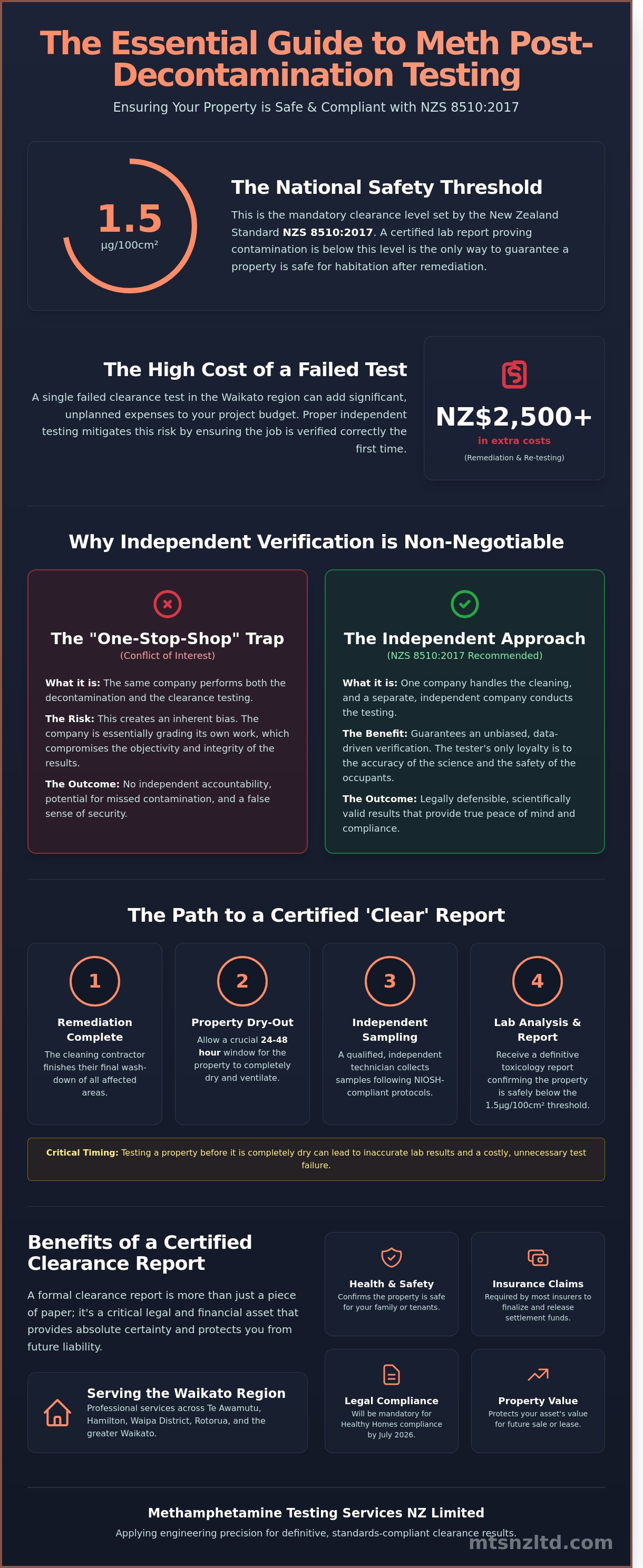
A successful cleaning process doesn't guarantee a safe building; only a rigorous, independent verification can confirm your property's health status. In the Waikato region, a single failed clearance test can add over NZ$2,500 in additional remediation and re-testing costs to your project budget. Engaging in professional post decontamination testing nz is the only technical safeguard against the residual health risks that persist after a meth lab or heavy use site has been remediated. We recognize that interpreting the technicalities of NZS 8510:2017 feels like a liability minefield for landlords and homeowners who require absolute certainty.
It's vital to have a clear, data-driven path toward property clearance. This guide provides the exact framework needed to secure a certified lab report proving that contamination levels are safely below the 1.5μg/100cm² threshold. We'll detail the precise steps for independent sampling across Te Awamutu and the wider Waikato to ensure your property transactions are legally protected and your tenants remain safe. You'll learn how to interpret laboratory results and why independent oversight is the cornerstone of establishing a risk-free environment for your family or investment.
Key Takeaways
Learn how to verify property safety by achieving the mandatory NZS 8510:2017 clearance threshold of 1.5μg/100cm² following meth remediation.
Understand the importance of independent post decontamination testing nz to avoid conflicts of interest and ensure unbiased verification of cleaning efforts.
Discover the technical requirements of NIOSH-compliant sampling protocols and the critical differences between screening and detailed individual area testing.
Access professional on-site property screening services across the greater Waikato region, including Te Awamutu, Hamilton, and the Waipa District.
Find out how Methamphetamine Testing Services NZ Limited applies engineering precision and professional reliability to provide homeowners with definitive, standards-compliant clearance results.
Table of Contents
What is Post-Decontamination Testing and Why is it Critical?
Post-decontamination testing represents the final technical verification stage in the meth remediation process. It's an objective assessment designed to confirm that hazardous residues have been successfully reduced to levels deemed safe for human habitation. While cleaning companies focus on the physical removal of contaminants, the testing phase provides the empirical data necessary to validate their work. This process is essential because methamphetamine residue is invisible to the naked eye. A property can appear pristine while still harbouring chemical concentrations that exceed the NZS 8510:2017 standard.
The primary objective of Clandestine Lab Remediation and subsequent testing is to ensure the property meets the national threshold of 1.5μg/100cm². This specific metric is the benchmark for safety in New Zealand. Achieving this level isn't just about peace of mind; it's a legal requirement for insurance claim finalisation. Most New Zealand insurers won't release final settlement funds without a clearance certificate. Additionally, this testing will be a mandatory component of Healthy Homes compliance by July 2026. Without a formal clearance report, property owners remain liable for potential health risks and face significant hurdles when attempting to sell or lease the asset.
The Goal of Post-Remediation Verification
We focus on validating that the remediation scope was sufficient to address the specific contamination profile of the building. This phase produces a definitive toxicology report that becomes a permanent part of the property file. In high-risk regions like Hamilton, Rotorua, or Te Awamutu, where property turnover is frequent, these reports provide the technical assurance required by future inhabitants. Our post decontamination testing nz methodology ensures that every surface area identified in the initial assessment now adheres to safety protocols. This data-driven approach eliminates the uncertainty associated with visual inspections.
When Should You Book Your Clearance Test?
Timing is a critical factor in the success of post decontamination testing nz. You shouldn't book the technician until the cleaning crew has finished their final wash down and the property has completely dried. This usually requires a 24 to 48-hour window after the final rinse. Testing too early can lead to inconclusive lab results because residual moisture or cleaning chemical odours can interfere with the sampling media. We require the environment to be neutral to ensure the absolute accuracy of the laboratory analysis. If the property hasn't been properly ventilated or dried, the risk of a false positive increases, which can lead to unnecessary and costly re-cleaning cycles.
The Conflict of Interest Trap: Why Independence Matters
The integrity of the remediation process relies entirely on the structural separation between the contractor performing the cleaning and the technician conducting the final assessment. In the New Zealand property market, "one-stop-shop" companies often bundle decontamination services with clearance testing. This model creates an inherent conflict of interest. When the same entity responsible for the physical labour also issues the final pass or fail grade, the objectivity of the post decontamination testing nz process is compromised. The NZS 8510:2017 standard explicitly recommends a separation of duties between the cleaner and the sampler to mitigate these risks. This technical barrier ensures that the validation of a property’s safety is based on empirical data rather than a desire to conclude a project quickly.
Independent reporting provides a necessary layer of accountability for decontamination contractors. Without an external audit, there's no technical oversight to ensure that the remediation met the rigorous NZ Ministry of Health Guidelines. Professional testers act as an impartial third party; their loyalty lies with the data and the safety of the future occupants, not the profit margins of the cleaning crew. This separation is the only way to guarantee that a property in Te Awamutu is truly clear of chemical residues before it's re-occupied.
The Risk of Self-Certification
Cleaners operating under a self-certification model face a significant financial incentive to "pass" their own work on the first attempt. If a sample fails, the contractor must often return to the site at their own expense to repeat the labour intensive cleaning process. This pressure can lead to the neglect of complex "hot spots" during the sampling phase, particularly in intricate renovations where residues may linger in HVAC systems or wall cavities. Independent sampling is the only mechanism that ensures total objectivity by removing financial bias from the validation process. By engaging a specialist who doesn't benefit from a "pass" result, homeowners receive an accurate snapshot of the property's health.
MTS NZ Ltd’s Unbiased Approach
Our operational framework is built on the principle of technical independence. MTS NZ Ltd does not perform cleaning or remediation services; our sole focus is delivering accurate, laboratory-grade reporting that withstands legal and financial scrutiny. Our protocols are specifically designed for high-stakes property transactions across Te Awamutu and the broader Waipa District. Because we operate independently, insurance providers and financial institutions accept our clearance certificates without dispute. We provide the technical certainty required to finalise property sales and insurance claims with confidence. For a professional assessment that prioritises accuracy over convenience, you can view our full range of testing services to ensure your site meets every regulatory requirement.
NZS 8510:2017 Standards for Post-Remediation Sampling
NZS 8510:2017 establishes the mandatory technical requirements for the remediation and testing of methamphetamine-contaminated properties in New Zealand. For post decontamination testing nz, this standard is the only acceptable framework to ensure a property is safe for habitation. We strictly adhere to NIOSH 9111 sampling protocols, which serve as the baseline for high-precision surface residue analysis. This methodology is consistent with international best practices, including the EPA Voluntary Guidelines, which underscore the necessity of systematic sampling to verify that cleanup efforts have successfully mitigated health risks. Without following these specific protocols, a clearance report lacks the legal and scientific weight required by insurers and local councils.
Detailed Individual Testing vs. Composite Sampling
Composite sampling, where multiple swabs are combined into a single laboratory vial, is often used for initial site screenings to reduce costs. However, it's insufficient for final clearance after a decontamination project. We require individual area testing to pinpoint any localized failures that a composite sample might mask. Our technicians focus on high-traffic and high-surface areas such as ceilings, HVAC vents, and window sills where residues frequently settle. We determine the exact number of samples based on the property's floor area; typically, we take at least one discrete sample per room to ensure the 1.5 µg/100cm² limit is met across the entire structure.
Laboratory-Grade Precision
MTS NZ Ltd does not use instant field kits for final clearance because they lack the analytical sensitivity required by NZS 8510:2017. We send every swab to independent, IANZ-accredited laboratories for Liquid Chromatography-Mass Spectrometry (LC-MS) analysis. This process identifies the "limit of detection," which in modern toxicology reports is often as low as 0.02 µg/100cm². This level of precision provides a definitive data set that field kits cannot replicate. We insist on providing full technical reports that include raw analytical data and chain-of-custody documentation, ensuring every client has a transparent record of the property's status.
A compliant clearance report must include several critical components to meet regulatory expectations:
A detailed site map that identifies every specific sampling location with precision.
Full laboratory results from an IANZ-accredited facility showing exact concentration levels.
A signed declaration that the property concentrations are below the 1.5 µg/100cm² threshold.
Comprehensive photographic evidence of the sampling process to prevent data tampering.
This structured approach ensures that post decontamination testing nz provides the certainty required for property transfers and re-occupancy. We don't accept "pass" or "fail" stickers; we provide the empirical evidence that proves a home in Te Awamutu is clear.
Waikato Regional Logistics: Te Awamutu, Hamilton, and Rotorua
Our operations across the Waikato region follow a rigorous logistical framework designed to provide technical oversight for residential and commercial assets. We maintain a consistent presence in the Waipa District, extending our specialized screening services to Te Awamutu and Pukeatua. Our methodology accounts for the distinct architectural differences found in the region. We apply different sampling protocols when assessing a 1920s villa in rural Waikato compared to a high-density modern build in Hamilton North. These older structures often require more intensive surface analysis due to the porous nature of historical building materials.
Service Areas: From Morrinsville to the King Country
Our mobile testing units are configured for rapid deployment across the Waikato, ensuring that post decontamination testing nz is accessible even in remote King Country locations. We recognize the high-pressure nature of the Hamilton and wider Waikato property markets, where settlement periods are often compressed into 10 working days. To support these timelines, we offer a 48-hour turnaround for site visits following a confirmed booking. Our team collaborates directly with property managers to facilitate tenant safety transitions, providing the objective data needed to verify that a property is fit for re-occupation.
Meeting Healthy Homes Standards in the Waipa District
Compliance with the Healthy Homes Standards 2019 is a mandatory requirement for landlords in Te Awamutu and the wider Waipa area. Professional testing serves as a technical pillar within these regulations. It provides a documented history of the property's environmental health. By adhering to the NZS 8510:2017 standards, we ensure that every assessment stands up to legal scrutiny. This level of certification is vital for maintaining property values; it offers a clear, historical record that protects the owner's investment against future liability.
Technical assessment of internal surfaces and HVAC systems.
Detailed reporting aligned with NZS 8510:2017 compliance.
Rapid response scheduling for urgent property settlements.
Analysis of building-specific risks in older Waikato housing stock.
The precision of our reporting helps stakeholders make informed decisions based on empirical evidence rather than speculation. We provide the technical clarity required to move forward with property transactions or tenancy agreements. If you require a professional assessment for your property, contact our technical team at Methamphetamine Testing Services NZ Limited to schedule a site visit.
Booking Your Post-Decontamination Test with MTS NZ Ltd
Verification represents the technical barrier between a remediation project and a safe occupancy. MTS NZ Ltd approach post decontamination testing nz with the same engineering precision applied to complex industrial projects. This methodology ensures that every sample reflects the actual state of the environment, adhering strictly to technical standards rather than subjective assessments. We focus on delivering data-driven results that provide property owners in Te Awamutu with absolute certainty regarding their investment.
The MTS NZ Ltd Professional Process
Our workflow is structured to eliminate error and maintain the chain of custody required for legal and insurance purposes. The process follows three distinct stages:
Step 1: Consultation and Quoting. We review the remediation scope and previous decontamination plans. This allows us to identify high-risk zones and determine the exact number of samples required to meet NZS 8510:2017 compliance. We provide a fixed-price quote based on these technical requirements so there are no hidden costs.
Step 2: On-site Sampling. Greg Brown personally conducts the site visit. He follows rigorous NZS 8510:2017 protocols, which involve precise 100cm² surface area sampling using laboratory-grade swabs. This level of detail ensures that laboratory findings are quantifiable and defensible in any legal or real estate context.
Step 3: Laboratory Analysis and Reporting. Samples are sent to an IANZ-accredited facility for analysis. We deliver a detailed technical report within 3 to 5 business days. This report clearly states whether the property meets the New Zealand standard of 1.5μg/100cm² for high-use areas.
Get the "All Clear" Today
Waikato residents choose MTS NZ Ltd because we maintain total independence. We don't perform remediation ourselves; our sole focus is on objective verification. This separation of interests is vital for post decontamination testing nz, as it ensures there's no conflict of interest during the final assessment. It’s the highest level of professional reliability you can secure for your property.
High-quality evidence is the foundation of a successful insurance claim. Our reports provide the specific data points that insurance providers require to close a file and confirm a property is once again habitable. We replace uncertainty with a comprehensive technical document that stands up to scrutiny from banks, insurers, and potential buyers. You'll have the evidence needed to move forward with confidence after a stressful decontamination process.
Securing Your Property’s Safety and Regulatory Compliance
Ensuring a property is safe for re-occupancy requires more than a visual inspection; it demands rigorous adherence to the NZS 8510:2017 standards. By prioritizing Independent Laboratory Analysis, property owners in Te Awamutu and the wider Waikato region eliminate the conflict of interest inherent when remediation firms test their own work. This professional separation is the only way to guarantee that the 1.5μg/100cm² limit for high-use areas is strictly met. It’s about technical precision and objective verification rather than guesswork.
MTS NZ Ltd provides the engineering-grade accuracy needed for definitive results. Our Local Waikato Experts deliver NZS 8510:2017 Compliant Reporting that stands up to legal scrutiny and insurance requirements. Whether you're managing a commercial site in Hamilton or a residential home in Te Awamutu, securing a professional post decontamination testing nz service is the final, essential step in your remediation project. We focus on technical excellence so you can restore your property with complete peace of mind.
Book your independent clearance test with MTS NZ Ltd to finalize your project with certainty and professional integrity.
Frequently Asked Questions
How long does post-decontamination testing take to get results?
Standard laboratory turnaround times for results typically range between 2 and 5 business days from the date of sample collection. If a project requires urgent clearance, we can facilitate 24-hour priority processing for an additional fee. This structured timeline ensures all analytical data undergoes rigorous verification to meet NZS 8510:2017 standards before we issue the final report.
Is it safe to move back in immediately after a "pass" result?
Occupants can safely re-enter the property once a formal Clearance Certificate is issued by the laboratory. This document confirms that methamphetamine residue levels have dropped below the 1.5 μg/100cm² limit established by New Zealand health regulations. It's essential to wait for this written confirmation because it serves as the legal proof that the remediation process successfully neutralized the identified chemical hazards.
What happens if the post-decontamination test fails?
A failed result requires the decontamination contractor to perform targeted re-cleaning in the specific zones where residues exceeded the 1.5 μg/100cm² threshold. Once this additional work is complete, a new round of post decontamination testing nz is mandatory to verify the effectiveness of the second cleaning phase. We continue this cycle of testing and remediation until every sampled area meets the required safety parameters.
Does insurance cover the cost of post-remediation testing in NZ?
Most New Zealand insurance policies provide coverage for testing and remediation costs, often capped at a limit of NZ$30,000 for meth-related claims. Coverage usually depends on whether the contamination is classified as sudden or accidental damage under your specific policy terms. You'll need to provide your insurer with the initial assessment report and the final clearance results to facilitate the claims process.
Can I use a DIY kit for post-decontamination clearance?
DIY kits aren't suitable for official clearance because they lack the precision and legal chain-of-custody documentation required by New Zealand courts and insurers. Professional technicians use NIOSH 9111 analytical methods to detect microscopic residues that retail kits often miss. Using a professional service ensures your results are scientifically robust and fully compliant with the NZS 8510:2017 industry standard.
How many samples are needed for a standard 3-bedroom house in Hamilton?
A standard 3-bedroom Hamilton property requires a minimum of 10 to 12 discrete samples to ensure a comprehensive safety assessment. This total includes individual swabs from every bedroom, the kitchen, living areas, and any attached garage spaces. Our technicians follow a systematic sampling grid to ensure that no high-contact surfaces are overlooked during the final post decontamination testing nz phase. The total number of tubes used is at the technician's discretion.
What is the safe limit for meth residue in New Zealand in 2026?
The legal safe limit for methamphetamine residue remains 1.5 μg/100cm² for high-use areas according to the NZS 8510:2017 standard. While there's ongoing debate regarding the 15 μg/100cm² threshold suggested by the Gluckman Report, the lower 1.5 μg limit is the current enforceable benchmark. Property owners should adhere to this stricter level in 2026 to ensure full compliance with residential tenancy laws and insurance requirements.
Why is MTS NZ Ltd considered an independent testing service?
MTS NZ Ltd maintains independence by strictly separating our technical testing services from any remediation or cleaning activities. We don't perform decontamination work, so we have no financial interest in the outcome of a test result. This clear division of labor guarantees that our assessments are objective, unbiased, and focused entirely on the technical accuracy of the environmental data we collect.


Comments