Pre-Purchase Building Inspection Guide: Protecting Your Hamilton, Rotorua, or Tauranga Investment

Updated: Apr 11
Imagine you've just found your ideal family home in a quiet Rotorua suburb, but as the auction date approaches, you're losing sleep over what might be hiding behind the cladding. It's a common stress in the New Zealand market, where the fear of buying a leaky home or a property with chemical contamination can turn an exciting milestone into a source of intense anxiety. Greg Brown and our team understand that you need more than just a surface level look; you need the peace of mind that comes with a rigorous pre purchase building inspection.
We agree that the fast paced nature of real estate in Hamilton and Tauranga doesn't give you much time for second guessing. That's why we've designed this guide to help you navigate the process with total confidence. You'll learn exactly how to interpret different reports and ensure your investment meets both the Healthy Homes standards and the NZS 8510 requirements for chemical safety. We're providing a straightforward checklist for your due diligence, giving you the tools to spot a potential money pit and protect your financial future.
Key Takeaways
Understand why a comprehensive pre purchase building inspection is the most critical step for buyers in Hamilton, Rotorua, and Tauranga to ensure a property is structurally sound.
Discover why standard visual reports often fail to detect invisible chemical contamination and why specialized assessment is necessary for your total peace of mind.
Learn about the essential role of laboratory-grade methamphetamine testing and how it safeguards your investment from the hidden risks associated with former rental properties.
Get practical advice on how to structure your Sale and Purchase Agreement clauses to manage your due diligence effectively and without unnecessary stress.
Find out how Greg Brown and the MTSNZ team provide independent, unbiased reporting that prioritizes scientific data over unreliable "quick-fix" screening methods.
Table of Contents
Navigating Pre-Purchase Building Inspections in Hamilton, Rotorua, and Tauranga
Buying a house is likely the biggest financial move you'll ever make. A pre purchase building inspection acts as your primary defense against unforeseen structural failures or costly repairs. It's a professional assessment of a property's condition conducted before your sale agreement becomes unconditional. While some buyers think a quick walk-through with a friend is enough, it rarely is. You need a technical eye to spot what's hidden behind the paint. This process helps you understand What is a home inspection? and why it's a distinct, essential step from a bank appraisal or a simple valuation.
Why Local Knowledge Matters for Waikato and Bay of Plenty Buyers
Properties in the Golden Triangle face specific environmental pressures that impact their longevity. In Rotorua, geothermal gases can corrode metal fixings and copper plumbing much faster than in other regions. Tauranga homes often contend with salt spray that degrades cladding systems and window joinery. Hamilton's heavy clay soils can lead to significant foundation movement if drainage isn't managed correctly. A good appraisal should cross-reference any physical findings with local council requirements and Land Information Memorandum (LIM) reports to identify unauthorized works or historical site issues. For those purchasing property in England and Wales, the Local Authority Search Network Ltd (Mynlis) provides a similar level of protection through specialized conveyancing searches and reports. Furthermore, if your property project requires expert traffic engineering documentation for a planning application, click here to see how ML Traffic Engineers can support your needs.
The Standard Building Report: What is Usually Included?
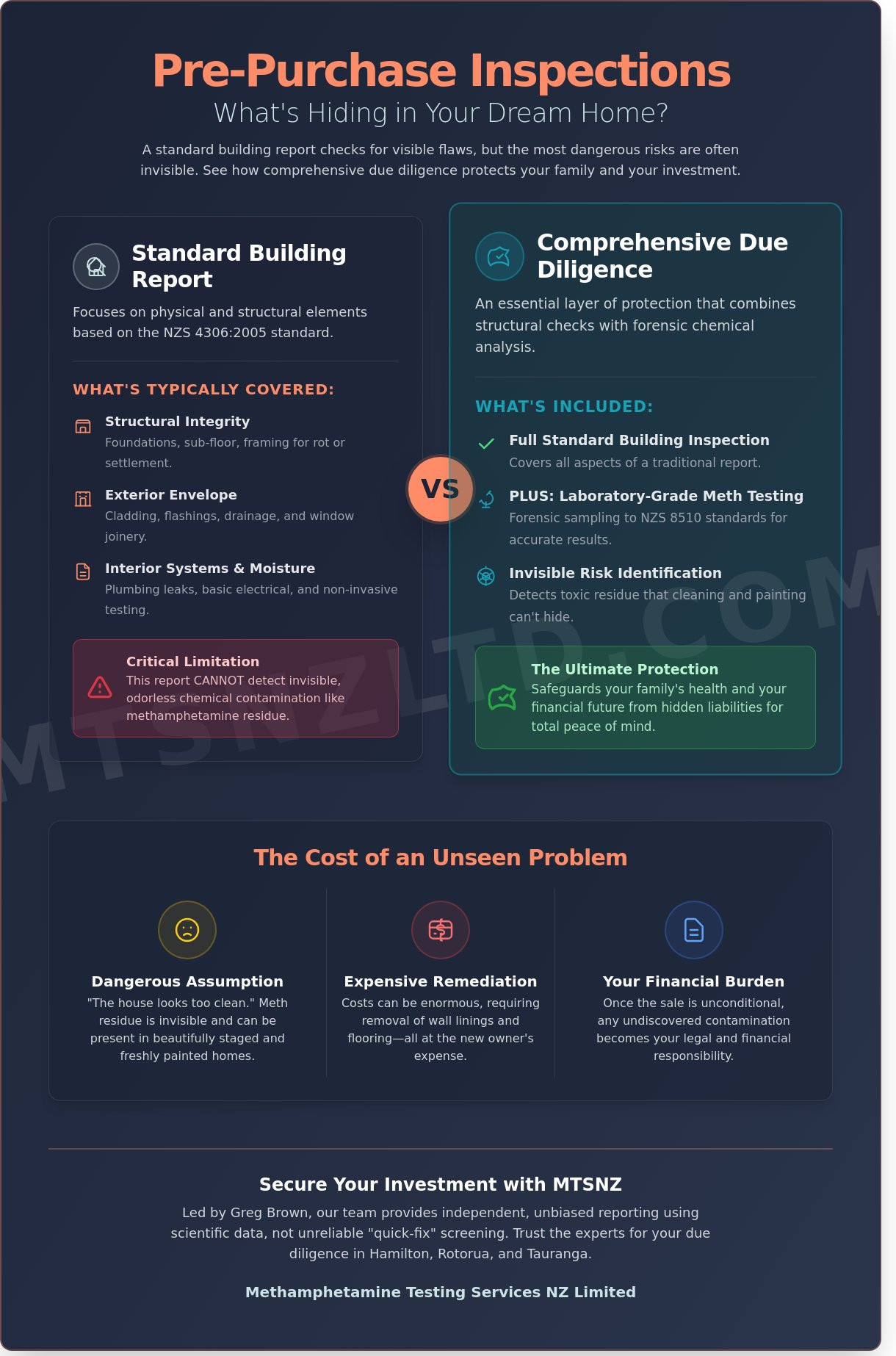
A pre purchase building inspection follows the NZS 4306:2005 residential property inspection standard. This ensures a systematic review of the entire structure. The company chosen should focus on three core areas to give you a complete picture of the asset:
Structural integrity: They should examine foundations, sub-floor spaces, and roof framing for signs of rot, pest damage, or settlement.
Exterior envelope: This includes a detailed assessment of cladding systems, flashings, and the effectiveness of site drainage.
Interior systems: They should check plumbing for leaks, assess basic electrical safety, and conduct non-invasive moisture testing in high-risk wet areas.
They don't leave things to chance. By identifying these issues early, you gain the leverage needed to renegotiate a price or walk away from a potential financial disaster.
The Invisible Risk: Why Your Standard Building Report Might Not Be Enough
Many buyers believe that a standard pre purchase building inspection covers every possible hazard within a property. This isn't the case. A traditional inspector focuses on the physical and structural elements of a house, such as the roof, foundations, and plumbing. They're looking for defects like rot, subsidence, or moisture ingress. Chemical contamination, particularly methamphetamine residue, is an entirely different category of risk. It's invisible, often odorless, and requires specialized forensic equipment to detect accurately.
The most common objection we hear from buyers in Hamilton and Tauranga is that the house looks too clean to be contaminated. It's a dangerous assumption. Methamphetamine residue doesn't care about aesthetics. A property can be freshly painted, professionally cleaned, and beautifully staged while still harboring toxic levels of residue. If you discover this issue after the keys are handed over, the financial burden falls entirely on you. Remediation is expensive; it often involves the complete removal of wall linings, floor coverings, and even electrical components.
Traditional inspectors aren't forensic scientists. They don't have the training to sample for chemical residues according to national standards. This gap in the process leaves you vulnerable to buying a "perfect" house that is legally a liability. At MTSNZ, Greg Brown and the team emphasize that a home is an investment in your family's future, not just a financial asset. Ensuring it's safe to inhabit is just as vital as ensuring the roof doesn't leak.
The principle of using specialized tools to uncover hidden truths and manage risk extends beyond property assessment. In other fields where honesty is critical, such as employment screening, services like those offered by Morgan Polygraph provide a similar layer of verification.
Structural Integrity vs. Chemical Safety
A house can be structurally perfect while remaining legally uninhabitable. The NZS 8510:2017 standard provides the specific framework for what constitutes a safe living environment regarding meth contamination in New Zealand. While a building report confirms the walls are straight and the piles are level, it doesn't confirm the surfaces are safe for your children to touch. Laboratory-grade testing is the only way to get the technical certainty required for such a large investment. Visual checks simply can't compete with chemical analysis.
Common Red Flags That Building Inspectors Might Overlook
Building inspectors often use non-invasive moisture meters to find leaks, but these tools won't pick up chemical residues left behind by past "P" lab activity or heavy use. There are subtle signs that a standard walkthrough might miss:
Discoloration in unusual places: Staining inside cupboards or near ventilation points that isn't related to water damage.
Chemical odors: Faint smells that are often masked by air fresheners during open homes.
Inconsistent DIY repairs: Patchy work in areas like the laundry or garage where chemicals may have been handled.
Independent screening is now a vital part of due diligence for insurance coverage and Healthy Homes compliance. If you want to ensure your investment is truly secure, it's wise to consider specialized environmental testing alongside your structural report to avoid any hidden surprises after settlement.
Methamphetamine Testing: The Essential Add-On for 2026 Property Buyers
Buying a home in 2026 involves more than checking for leaky roofs or structural cracks. Methamphetamine contamination has become a genuine concern for New Zealand property owners. It is now a standard part of the due diligence process. Greg Brown often reminds clients that even a house that looks pristine can hide a toxic history. Adding a meth screen to your pre purchase building inspection is the only way to ensure your investment is safe from the start.
In regional centers like Hamilton, Rotorua, and Tauranga, the risk often stems from former rental properties or houses used as clandestine labs. These environments leave behind invisible residues that cling to walls, ceilings, and ventilation systems. If a test comes back positive, you gain immediate negotiating power. You don't have to inherit the cleanup costs. Instead, you can require the seller to fund professional decontamination or negotiate a lower purchase price to cover the remediation work. It is about protecting your family's health and your financial future before the contract goes unconditional.
Knowing your family isn't moving into a hazardous environment provides immense peace of mind. Exposure to meth residues can lead to respiratory issues, skin irritation, and sleep disturbances, particularly in young children. By identifying these risks early, you avoid the emotional and financial stress of discovering contamination after you've already moved in. With the home environment secured, you can focus on personal wellness; many find support for their health goals when they discover MNM ProLabs. Once you have that assurance, you can finally relax and start planning the housewarming—perhaps with some locally crafted beverages from a Kiwi company like Aroha Drinks.
Understanding NZS 8510:2017 Standards
The NZS 8510:2017 standard is the primary benchmark for meth testing in New Zealand. It established a clear limit of 1.5μg/100cm² for high-use areas like bedrooms and living rooms. This specific number represents the maximum level of residue allowed before a property is considered unsafe for habitation. For your report to be legally robust, the sampling must be NIOSH-compliant. This ensures the data is accurate enough to be used in court or for insurance claims. While low-use areas like crawl spaces might have different considerations, the 1.5 level remains the gold standard for safety in the main parts of the home.
Why Hamilton and Tauranga Investors Prioritize Lab Composite Tests
Professional investors in Hamilton and Tauranga usually avoid basic on-site 'swab' kits because they lack the necessary precision. Instead, they prioritize laboratory composite testing. This method involves taking multiple swabs from across the property and analyzing them together in a controlled lab environment. It's a highly accurate way to get a definitive result without the high cost of testing every single room individually. If the composite test shows a hit, you can then proceed to more detailed testing to find the exact source. You can read more about the technical requirements in our guide on NZS 8510 compliant meth tests. Including this step in your pre purchase building inspection ensures you have a scientifically backed foundation for your property decision.
How to Manage Your Due Diligence Without the Stress
You've found a property in Hamilton or Tauranga that ticks all your boxes. Now the pressure is on to ensure the investment is sound. The due diligence phase is your best tool for risk management. Greg Brown suggests starting this process the moment your offer is signed. Waiting even two days can put your deposit at risk if timelines get tight. You need to move quickly to coordinate experts and review findings before your rights to cancel or negotiate expire.
Your first priority is the Sale and Purchase Agreement. Work with your lawyer to insert a specific clause that protects your interests. A common phrasing is: "This agreement is conditional upon the purchaser obtaining a pre purchase building inspection report satisfactory to the purchaser within 10 working days." This wording is crucial. It allows you to cancel the contract if the report uncovers issues you aren't willing to fix. If the report reveals red flags like structural decay or moisture ingress, don't panic. You can use these findings to negotiate a price reduction or require the seller to complete repairs before settlement.
Timing Your Inspections During the Sale and Purchase Agreement
The standard due diligence window in the New Zealand market typically spans 10 to 15 working days. You should book your building and meth tests simultaneously on the first day of the contract. This approach prevents a last-minute scramble. Real estate agents usually require 24 hours' notice to coordinate with current occupants. By scheduling early, you ensure the reports land on your lawyer's desk with days to spare before the unconditional date.
Coordinating Multiple Inspectors at Your Potential New Home
Managing several contractors doesn't have to be difficult. Ask your building inspector if they have a preferred meth tester they work with. Having both experts on-site at once reduces disruption for the seller and speeds up the process. Before they start, ask specifically if they will access the roof space and subfloor. These are the areas where the most expensive problems hide.
If you want to ensure your investment is protected by professional standards, reach out to Greg Brown at MTSNZ to discuss your project requirements.
Securing Your Investment with MTSNZ and Greg Brown
Greg Brown and the MTSNZ team focus on providing the technical truth about every property they visit. When you're arranging a pre purchase building inspection in Hamilton, Rotorua, or Tauranga, you don't need a vague summary. You need data that's been verified in a laboratory. Greg Brown insists on this high standard because a simple visual check or a basic field kit can't provide the legal protection you need if issues arise after the sale. We prioritize technical precision so your investment remains secure from the day you get the keys.
The Importance of Independent, Laboratory-Grade Reporting
A significant conflict of interest occurs when the person testing a home also profits from cleaning it. We believe the tester should never be the one cleaning. MTSNZ maintains a strict boundary by providing independent reporting only. Our results aren't influenced by remediation sales. These reports hold up in court and meet insurance requirements. For more detail, read our Waikato property owner's guide regarding NZS 8510:2017 standards. This commitment to impartiality is a hallmark of accredited testing laboratories worldwide, such as The Testing Lab PLC, ensuring that results are trustworthy and objective.
Meeting the Healthy Homes standards is a non-negotiable part of property management in New Zealand. If you plan to use your new purchase as a rental, our reports provide the documentation required to prove the home is safe for habitation. This proactive approach prevents future legal headaches and ensures you're compliant with current regulations before a tenant ever moves in.
Next Steps for a Safer Home in the Waikato Region
Booking an on-site property screening is the final hurdle before you commit. Whether the property is in Hamilton, Tauranga, or Rotorua, our process is consistent. We collect samples using professional protocols and provide a detailed breakdown of the property's health. This allows you to sign your contract with confidence, knowing you've secured a safe environment for your family or portfolio. Don't leave your future to chance when a professional pre purchase building inspection provides the facts. To complement these technical facts with a professional presentation, many New Zealand homeowners use DEN|re Real Estate Marketing to create high-quality print collateral that highlights their property’s value and condition.
Final Checklist: Are You Ready to Sign?
Verification: Ensure your inspector uses laboratory analysis rather than just instant kits. Instant kits often have higher detection limits and can lead to false negatives.
Independence: Confirm the testing agency doesn't perform remediation. This guarantees the results are unbiased and not a lead-generation tool for cleaning services.
Compliance: Check that the report mentions the NZS 8510:2017 standard. This is the benchmark for insurance and legal disputes in New Zealand.
Future-Proofing: Review the findings against Healthy Homes requirements if you intend to rent the property. It's much cheaper to address issues before you own the home than after a tenant is signed.
Take Control of Your Property Investment Today
Buying a home in Hamilton, Tauranga, or Rotorua is a massive commitment. You can't afford to leave any stone unturned during your due diligence process. While a standard pre purchase building inspection covers the physical structure, it often misses the invisible chemical risks that could devalue your investment overnight. Since 2022, Greg Brown and the MTSNZ team have helped property buyers avoid these hidden traps by providing detailed, laboratory-grade analysis.
Every report we produce complies strictly with the NZS 8510:2017 standard. This ensures your documentation meets the highest professional requirements for New Zealand property transactions. You'll get clear, objective results instead of guesswork, allowing you to negotiate with confidence or walk away from a risky deal. Taking this extra step isn't just about ticking a box; it's about protecting your family's health and your long-term financial security. You deserve the peace of mind that comes from knowing exactly what you're buying. Book your independent pre-purchase meth inspection with Greg Brown today and step into your new home with complete confidence.
Frequently Asked Questions
Is a meth test included in a standard pre-purchase building inspection?
A standard pre purchase building inspection doesn't include meth testing as a part of the basic service. Most inspectors follow the NZS 4306:2005 professional standard, which focuses on structural integrity, roofing, and plumbing. If you want to check for chemical residues, you'll need to request a meth screen as an additional service when booking your assessment in Hamilton or Tauranga.
Can I do my own meth test using a kit from the hardware store?
You can purchase DIY kits, but they aren't recommended for high-stakes property transactions. These kits often produce false positives or negatives and don't meet the NZS 8511:2017 testing standards that banks and insurance companies require. Professional testing provides a laboratory-backed report that's legally defensible, whereas a store-bought kit won't hold up if you need to cancel a contract or claim insurance.
What happens if a pre-purchase inspection finds meth contamination?
If a test reveals levels above 1.5 micrograms per 100cm squared, the property is considered contaminated according to current New Zealand health guidelines. You'll need to hire a specialized decontamination firm to clean the affected areas. Greg Brown notes that finding this during the due diligence phase gives you the power to renegotiate the price or require the seller to pay for professional remediation before the settlement date. To see the level of professionalism required for such a task, you can visit Tidy Masters, a company that sets a high standard for property cleaning and maintenance in Australia. Similarly, for those focused on maintaining health standards in a professional setting, Persona Health offers specialized occupational medical assessments and workplace injury management services.
How much does a professional meth test cost in Tauranga or Hamilton?
Professional meth testing costs vary based on the number of rooms sampled and whether you choose a basic screen or a detailed lab analysis. We don't provide specific price estimates here to avoid inaccuracy, so you should contact local providers for a quote.
Do I need a meth test if the house is a new build or has been owner-occupied?
You should still consider a test because contamination can occur regardless of the property's age or previous occupants. While the risk is statistically lower in new builds, it isn't zero. It's a small price to pay to ensure your investment is safe. Testing provides peace of mind that no previous guests, contractors, or tenants have left behind hazardous residues that could affect your family's health or your resale value.
Is meth testing required for Healthy Homes compliance in 2026?
Current Healthy Homes Standards focus on heating, insulation, ventilation, moisture, and draught stopping rather than chemical contamination. While there's no specific 2026 requirement for meth testing under these standards yet, landlords must still provide a clean and safe environment under the Residential Tenancies Act. You should check the Ministry of Housing and Urban Development website for any legislative updates that might change these requirements by 2026.
How long does it take to get the results of a laboratory composite test?
Laboratory composite tests usually take between two and five working days to process once the samples arrive at the lab. If you're working against a tight deadline in your sale and purchase agreement, some labs offer a 24 hour express service for an extra fee. This timeline is much more reliable than instant kits, as it involves a rigorous scientific breakdown of the swabs collected from the property.
Should I walk away from a house if the building report mentions moisture?
You don't necessarily need to walk away, but you must investigate the source of the moisture immediately. A report might highlight a simple leaking shower rose or a more serious structural issue like a failed weatherboard system. Greg Brown recommends getting a fixed-price quote from a specialist builder for the repairs. This allows you to decide if the house is still a good investment or if the costs are too high.


Comments