How to Read a Meth Test Report in NZ: A Waikato & Bay of Plenty Guide

Last Tuesday, a family in Hamilton sat at their kitchen table staring at a document that looked more like a high school chemistry exam than a property assessment. They knew they needed to understand the meth test report nz results before committing to their mortgage, but the technical jargon felt like a massive wall between them and their new home. It's frustrating when you're trying to make a responsible decision for your future but feel blinded by complex laboratory data and conflicting safety advice.
Greg Brown and our specialist team believe that every homeowner in the Waikato and Bay of Plenty deserves total clarity when it comes to property health. We've designed this guide to help you interpret those confusing microgram readings and safety standards so you can proceed with your house sale or rental with absolute confidence. You'll learn exactly how to spot a verified clean status for insurance purposes and understand what the current decontamination requirements mean for your specific investment.
We'll walk you through the precise benchmarks used in Tauranga and Rotorua today, clearing up any confusion regarding NZ standards so you can distinguish a safe environment from a potential liability.
Key Takeaways
Understand exactly what a meth test report reveals about chemical residues, helping you navigate pre-purchase due diligence in the Waikato with total confidence.
Learn to distinguish between budget-friendly composite screening and detailed individual testing so you can pinpoint issues in specific rooms across Rotorua and Tauranga properties.
Master the technical jargon and safety thresholds within a meth test report nz to ensure your home meets the NZS 8510:2017 standards for insurance and legal compliance.
Spot critical red flags by verifying IANZ accreditation and NIOSH sampling methods to ensure your lab results are reliable and accurate.
Gain a clear action plan for what to do after receiving your results, from securing Healthy Homes certification to navigating the post-decontamination process.
Table of Contents What Exactly is a Meth Test Report in the NZ Property Market? Decoding the Jargon: Composite vs. Individual Lab Results Understanding NZS 8510:2017 and Safety Thresholds How to Spot Red Flags in Your Meth Test Report Next Steps: What to Do After Receiving Your Report
What Exactly is a Meth Test Report in the NZ Property Market?
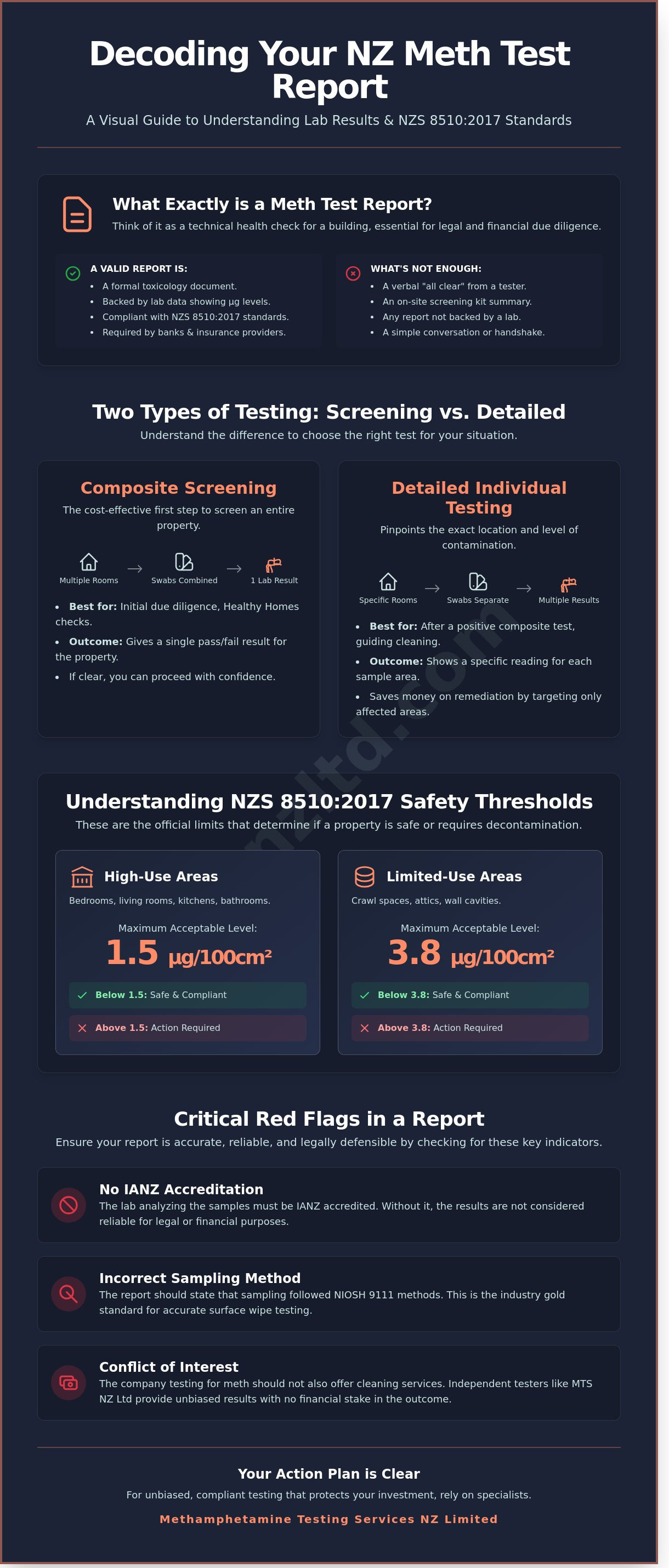
A meth test report nz is a formal toxicology document that outlines the specific chemical residue levels found within a property. Think of it as a technical health check for a building. Greg Brown and the MTS NZ team focus on producing reports that strictly adhere to the NZS 8510:2017 standards. This specific standard was introduced on June 29, 2017, to ensure consistency and safety across the industry. Without a report that meets these criteria, you're essentially flying blind during a property transaction.
You might encounter a tester who offers a verbal "all clear" after a quick walk-through. In the current New Zealand market, this isn't worth much. Your bank and insurance provider won't accept a conversation as proof of safety. They require a physical or digital document backed by laboratory data. To understand the background of these chemicals, you can read more about What is Methamphetamine? to see why these residues are tracked so closely. A formal report protects your investment by providing a paper trail that satisfies legal and financial requirements.
The Role of Reports in Hamilton and Tauranga Real Estate
In Hamilton and Tauranga, meth testing clauses are standard in Sale and Purchase agreements. Buyers use these reports for due diligence, while Waikato landlords need them for Healthy Homes compliance. It's vital to distinguish between a quick on-site screening summary and a full lab report. While screening kits offer a fast result, only a lab report provides the precise microgram levels required for legal and insurance purposes.
Who is Greg Brown and Why Independence Matters?
Greg Brown operates MTS NZ with a philosophy of delivering facts without fluff. He maintains strict professional independence by not offering cleaning or remediation services. This removes any conflict of interest. Because Greg doesn't have a financial stake in the cleaning process, his reports are viewed as unbiased, neutral evidence. This independence is exactly what makes a meth test report nz hold up during a Tenancy Tribunal hearing.
Decoding the Jargon: Composite vs. Individual Lab Results
When you first look at a meth test report nz, the technical terms can feel like a different language. Greg Brown and the team at MTS NZ Ltd focus on making these results easy to understand so you can make informed decisions about your property. The most important distinction you'll encounter is the difference between composite and individual lab results. Understanding this helps you decide whether you're looking at a clean bill of health or the start of a cleanup project.
How Composite Lab Analysis Works
A laboratory composite test is the most cost-effective way to screen a house in Rotorua or across the Bay of Plenty. During this process, the technician takes swabs from various rooms, but the lab combines them into a single sample for analysis. This gives you one overall reading for the entire property rather than a room-by-room breakdown. It's a smart way to get a high-level view without the expense of multiple individual tests.
The lab calculates a potential maximum based on this combined data. If a five-room composite returns a result of 1.0 µg/100cm², it doesn't necessarily mean every room has that level. It means the average across those rooms is 1.0, but the actual concentration in one specific room could be higher. This approach follows the NZS 8510:2017 standard, ensuring the testing is rigorous and legally defensible. MTS NZ Ltd prioritises Laboratory Composite Methamphetamine Tests for initial screenings because they provide a high level of certainty. If the composite result is clear, you can move forward with confidence.
When to Opt for Detailed Individual Testing
Individual testing is the next step when a composite test shows a positive result above the safety limits. It shifts the focus from identifying a presence to pinpointing the exact location of the contamination. For Waikato homeowners, this data is the blueprint for any necessary decontamination work. It takes the guesswork out of the process by showing exactly which surfaces need attention.
Instead of treating the whole house, individual results might reveal that the kitchen is the only affected area. This precision is worth the extra lab fees because it prevents you from paying for cleaning services in rooms that don't need it. You're investing in data that could save you thousands in remediation costs. If you've just received a meth test report nz and aren't sure what the numbers mean for your next steps, feel free to reach out to us for a professional breakdown of your options.
Understanding NZS 8510:2017 and Safety Thresholds
Every meth test report nz owners receive should be anchored in the NZS 8510:2017 standard. This document provides the engineering-grade framework for how technicians collect samples and how labs interpret the data. In 2026, the conversation around safety has shifted toward a more pragmatic approach. While the 2017 standard was originally quite conservative, the industry has largely adapted to clarify the difference between manufacturing contamination and simple smoking residue. If your report doesn't explicitly mention its compliance with these New Zealand standards, it lacks the legal weight needed for insurance or real estate transactions.
The 15 Microgram Threshold Explained
The number you'll see most often is 15 μg/100cm². This threshold is currently used to define what's "safe to live in" for most residential properties. It's not a one size fits all figure, though. The standard looks at high-use areas like bedrooms and living rooms differently than low-use areas like crawl spaces or sheds. If your report shows a level "Below Detection Limit" (BDL), it means the lab's equipment couldn't find any trace of the substance. This is the ideal result for any property owner. However, levels between BDL and 15 μg/100cm² still indicate the presence of meth, even if they don't trigger a mandatory decontamination requirement under current guidelines.
Gluckman vs. The Standard: The Great NZ Debate
There's a significant disconnect between the 2018 Gluckman Report and the official NZS 8510:2017 standard. The Gluckman Report suggested that 15 μg/100cm² was a safe limit for properties where meth was only smoked. Despite this, many banks and insurers still default to the stricter 2017 standard when assessing risk. Greg Brown often advises clients that "clean" is a relative term. What's legally acceptable for a rental might not be acceptable to a cautious buyer in Tauranga or Hamilton. If you're looking at meth testing in the Waikato, you'll find that following the 2017 protocols is the only way to ensure your report stands up to scrutiny during a sale. Conflicting information from the media can be confusing, but your meth test report nz results remain the final word for legal and financial protection. You need a document that balances these scientific findings with the practical realities of the NZ property market.
How to Spot Red Flags in Your Meth Test Report
A high-quality meth test report nz serves as your primary defense against property liability. Greg Brown maintains that technical accuracy is the only way to ensure a property is truly safe for habitation. When you review your document, you should look for specific markers of professional integrity. If these markers are missing, the report might not protect you in a Tenancy Tribunal hearing or a real estate dispute. Since the introduction of the NZS 8511:2017 standard, the requirements for documentation have become much stricter.
IANZ Accreditation: Always verify that the laboratory used is IANZ (International Accreditation New Zealand) accredited. This certification ensures the lab operates under the ISO/IEC 17025 standard for testing and calibration. If the lab lacks this, the data is technically unverified.
NIOSH 9111 Compliance: The report must state that samples were collected following NIOSH 9111 methods. This is the globally recognized industry standard for surface wipe sampling. If the tester used an unverified method, the results are often scientifically invalid.
Conflict of Interest: Check if the company providing the test also offers decontamination or cleaning services. This is a significant red flag. A tester should have no financial interest in whether a property fails or passes; their only goal is providing objective data.
The Sampling Map: For a home in Waipa or anywhere in the Waikato, the report must include a clear floor plan. You need to see exactly where each swab was taken to understand the specific spread of any detected contamination.
Reading the Lab Data Table
The data table is the core of the meth test report nz. Every entry should have a unique Sample ID that corresponds directly to the site map provided by the tester. Pay close attention to the units of measurement. Professional surface testing uses micrograms per 100 square centimeters, written as μg/100cm². If you see units like mg/kg, that usually refers to bulk materials or soil, which indicates the wrong protocol was used for a residential surface test. If a result is marked as "Inconclusive," it means the lab could not provide a definitive reading due to technical interference or sample contamination. This requires an immediate follow-up test to ensure the safety of the occupants.
The Importance of a Site Map and Photos
A report without visual evidence is a major concern for Waikato property managers. Photos provide proof that the tester actually visited every room in a Rotorua property and performed the work according to the NZS 8511:2017 guidelines. Each photo should show the specific swab area and the tamper-proof seal used for that sample. This establishes a clear "Chain of Custody" from your front door to the laboratory. Without this documentation, it is impossible to prove that the samples analyzed by the lab actually came from your property. High-quality reports include timestamped images of the exterior and interior to prevent any legal challenges during a sale or tenancy change.
If you suspect your current documentation is missing these critical details, contact us for
that meet all New Zealand standards.
Next Steps: What to Do After Receiving Your Report
Receiving your meth test report nz is a milestone in your property journey, whether you're buying, selling, or managing a rental. If the results show levels below the NZS 8517:2017 standard of 1.5μg/100cm², you have a valuable asset for your records. This document serves as definitive proof of compliance for Healthy Homes standards. Insurers in the Waikato and Bay of Plenty often require this specific documentation to maintain your cover or to process claims related to chemical damage.
If the results come back positive for contamination above the 1.5μg threshold, you need a clear roadmap for remediation. Greg Brown emphasizes that decontamination is a process, not a single event. Once the professional cleaning is finished, you'll need to arrange for post-decontamination testing in the Waikato. This final clearance ensures the property is truly safe for habitation and provides a clean slate for your insurance and future tenants.
Beyond the chemistry of the walls, you should consider the physical structure of the building. Greg Brown recommends getting a pre-purchase building inspection alongside your meth screen. While the meth test identifies chemical risks, the building inspection identifies structural ones. Together, these reports give you a 360-degree view of your Hamilton, Rotorua, or Tauranga investment, ensuring you aren't walking into a financial trap.
Using the Report for Negotiations
When your meth test report nz reveals contamination in a property you're looking to buy, it becomes a powerful tool for negotiation. You should present the lab-certified data to the vendor immediately. If the initial screen was a composite test, Greg Brown often suggests requesting a "detailed" test. This involves testing individual rooms to pinpoint the exact scope of the issue. Often, a detailed test reveals that contamination is limited to a single area, which can significantly lower the estimated cleaning costs and help you negotiate a realistic price reduction. Always discuss the report with your lawyer; these documents hold significant legal weight during the due diligence period.
Long-term Storage and Compliance
Think of your meth report as a permanent part of the property's history. You should keep this document for as long as you own the home. Providing a clear report to future tenants is a proactive way to build trust and transparency from day one of a lease. It sets a standard for the property and protects your investment. For landlords with high-turnover rentals in areas like Hamilton or Tauranga, Greg Brown’s final tip is to implement regular baseline testing between tenancies. This practice ensures that any future contamination is caught early and can be attributed to the correct period, saving you from costly disputes and remediation bills later on.
Take Control of Your Property's Safety Standards
Navigating the technical details of a meth test report nz doesn't have to be a headache. You now understand how to distinguish between composite screenings and individual lab results, which is a vital step in identifying potential contamination levels. By focusing on the NZS 8510:2017 safety thresholds, you can spot red flags before they become costly liabilities for your family or your portfolio. Greg Brown and the MTS NZ team have provided lab-certified, independent testing across Hamilton, Rotorua, and Tauranga since 2017. Every report we produce remains fully compliant with NZS 8510:2017 standards to ensure you have the most reliable data possible for your decision making process. Protecting your investment starts with professional clarity and unwavering accuracy. We've seen how much peace of mind a clear, independent report provides to buyers and sellers alike. Don't leave your property's health to chance when you can rely on proven expertise. Book your independent meth test with Greg Brown and the MTS NZ team today. We're here to help you move forward with total confidence in your next property venture.
Frequently Asked Questions
What is the difference between a screening test and a laboratory report?
Screening tests give a quick yes or no result on-site, but a laboratory report provides the exact levels of contamination. Screening is faster but lacks the forensic detail found in a professional meth test report nz. Lab reports involve sending samples to accredited facilities like Hill Laboratories for detailed analysis. This process ensures the data is accurate enough for legal or insurance purposes.
How long does it take to get a meth test report back in Waikato?
You'll typically receive your results within 48 to 72 hours after the technician visits your property. For properties in Hamilton or Cambridge, local courier schedules often allow for a next-day laboratory turnaround. Greg Brown ensures that reports are processed quickly to meet the tight deadlines often required for property settlements or urgent tenancy agreements in the Waikato region.
Does a positive meth test mean the house was a "P-lab"?
A positive result doesn't automatically mean the property was a manufacturing site. Most positive detections in New Zealand come from previous occupants smoking the substance. The NZS 8511:2017 standard differentiates between high-level manufacturing contamination and lower levels from personal use. You'll need a detailed forensic assessment to confirm if chemical precursors used in "cooking" are actually present in the building materials.
Can I use a DIY meth test kit for a Healthy Homes report?
DIY kits aren't acceptable for official Healthy Homes compliance or professional property transactions. While retail kits provide a quick indication, they don't meet the NZS 8511:2017 testing standards required for legal documentation. A certified technician must collect the samples and provide a formal meth test report nz to ensure the data is legally defensible and recognized by the Tenancy Tribunal.
Will my insurance cover a meth test report if I suspect a tenant was smoking?
Insurance coverage depends on your specific policy and the "sudden and accidental" damage clauses included. Many major New Zealand insurers require evidence of regular inspections or professional testing between tenancies to honor a claim. You should check your policy wording regarding the 30,000 dollar limit often applied to decontamination and testing costs in standard landlord policies across the country.
What does "Below Detection Limit" (BDL) mean on my NZ lab report?
BDL means the laboratory equipment couldn't find any traces of methamphetamine above their technical threshold. This threshold is usually 0.02 micrograms per 100cm squared in New Zealand labs. It's the best possible result you can get on a report. This indicates the property is effectively clear of detectable contamination and is safe for occupation according to current health guidelines.
Do I need a meth test report for a brand new house in Tauranga?
You don't legally need a report for a new build, but many buyers in Tauranga get one as a baseline for future protection. This documentation proves the house was clean before the first tenants or owners moved in. It serves as a vital reference point if you ever need to prove when contamination occurred during a future insurance claim or legal dispute.
How much does a standard meth test report cost in the Waikato region?
Costs for testing vary based on the number of samples taken and the size of the dwelling. We recommend checking the latest figures from the Real Estate Institute of New Zealand (REINZ) or requesting local provider quotes. Factors like travel to rural Waikato locations or urgent 24-hour processing fees will influence the final invoice amount you receive from the testing company.


Comments